Culture Index Alternatives for Small Business Hiring From $49 a Month
The closest Culture Index alternatives are the Predictive Index, Caliper and Hogan, which also sell behavioral or personality profiles through quotes and certified users. If your real problem is finding out which applicants can do one specific job, the cheaper alternative is a job-specific skills test. Culture Index does not publish a price (third-party estimates start around $5,000 a year); Assessing AI starts at $49 a month with no contract.
Type the role into the generator and look at the questions it drafts. If you want an advisor-led behavioral framework for running the whole company, Culture Index does that and we do not, and the comparison below says so.
Draft a test for the job you are filling
No account needed to build your first test. Results appear instantly in your dashboard.
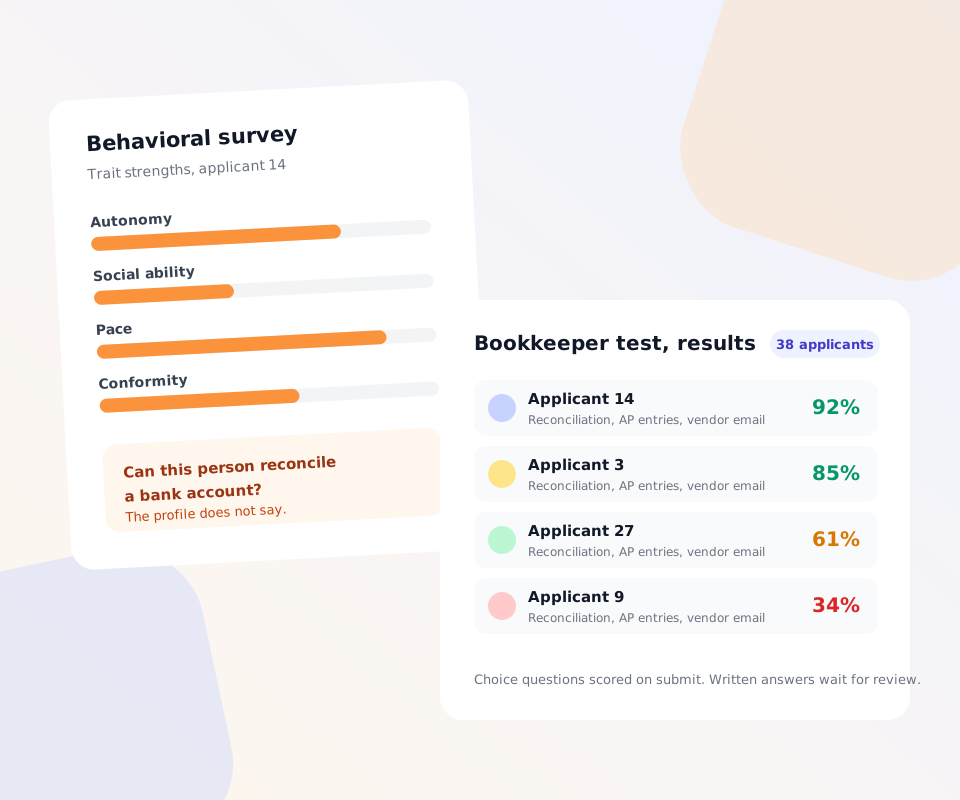
A job test shows whether they can do the work, a profile does not
A Culture Index survey tells you how strongly someone leans toward autonomy, social contact, pace or rule-following. It does not tell you whether your next bookkeeper can reconcile a bank account or whether a service coordinator can calm an angry customer. A ten-question test on those tasks does, and every applicant answers the same questions.
- Choice questions scored the moment applicants submit
- Written and recorded answers reviewed in one place
- One link in the job post, no candidate account
Why owners look for a Culture Index alternative
Culture Index has loyal fans, especially among founders who use it to design teams. The owners who go looking for an alternative usually have no quarrel with the survey itself. They hit friction with the price, the format or the question it actually answers.
No price until the call
There is no pricing page. The fee comes out of a sales consultation and is shaped by headcount and scope, so you cannot compare it with anything until you have already spent an hour with a sales rep.
Five figures at modest size
Software Finder estimates Culture Index at roughly $5,000 to $20,000 or more a year, rising with company size. For a business that hires eight people a year, the low end alone is $625 per hire.
Training per administrator
Results are read by trained people inside your company. The same estimate puts that training at about $2,000 per administrator, a cost that repeats every time the person who reads the reports leaves.
Behavior only, no cognitive test
The survey is a ten-minute adjective checklist that maps seven traits. The Predictive Index points out on its own comparison page that Culture Index has no cognitive assessment, and it has no job knowledge test either.
Advisory engagement, not software
Part of what you pay for is access to a Culture Index advisor and their framework. That is valuable if leadership will use it weekly, and dead weight if all you wanted was a cleaner shortlist.
Hard to explain to candidates
Applicants who answer an adjective list often cannot see how it relates to the job. A test built from the job post reads as fair because the questions are obviously about the work.
How to replace a Culture Index screen with a job test this week
List what the hire must already know
Pick the two or three tasks the person has to handle in the first month. For a bookkeeper that might be bank reconciliation and vendor bills; for a front desk role, scheduling and difficult callers. That list becomes the test.
Generate the first draft
Paste the job description or type the role. On Plus, the AI drafts multiple choice, written and recorded answer questions for that job in under a minute.
Edit and set the rules
Delete anything that does not match your business, add a question about your own software or process, set a time limit and shuffle the question order.
Send one link and sort the list
Put the link in the job post or your auto-reply. Choice questions are scored on submit, your team scores the written and recorded answers, and you sort everyone by total score before booking a single call.
Culture Index alternatives compared on price and fit
Figures come from each vendor's own pricing page where one exists, otherwise from the listing, distributor or estimate named in the cell. Quote-only vendors are labeled as such. Prices change, so confirm before you sign.
| Tool | Price | What it measures | Contract | Where it wins |
|---|---|---|---|---|
| Culture Index | Quote only; Software Finder estimate $5,000 to $20,000+ a year plus about $2,000 per admin trained | Seven behavioral traits from a 10 minute adjective survey | Engagement, set in the quote | Advisor-led framework for team design, unlimited surveys |
| Predictive Index Talent | From $10,000 a year (PI plans page); Vendr median $12,974 | Four behavioral drives, optional cognitive test, job matching | Annual, scales with headcount | Software anyone can use, cognitive test included, unlimited users |
| Caliper Profile (Talogy) | No public price; commonly quoted at about $265 per profile; subscriptions sold through sales | 21 personality traits plus abstract reasoning, about 60 to 75 minutes | Per profile or subscription | Detailed fit report against a job model, long track record in sales hiring |
| Hogan | Certification $3,050 per person; a US distributor lists the Candidate Summary at $170 | HPI, HDS and MVPI personality inventories | Per report, after certification | Leadership and executive selection, derailer data |
| Wonderlic Select | Quote by package and employee count; listings from $1,000 to $6,000+ a year | Cognitive ability, motivation and personality | Annual | Short cognitive test, 1,100+ job profiles |
| TestGorilla Core | From $215 a month, billed annually (about $2,580 a year) | Library of skills, cognitive and personality tests | Annual | Large validated library, published price |
| Assessing AI Starter | $49 a month, or $288 a year | Your own job-specific questions, including recorded answers | Monthly, no contract | Lowest flat price, 500 responses a month, 3 team members |
| Assessing AI Plus | $149 a month, or $888 a year | Same, with AI question drafting and manual scoring of written and recorded answers | Monthly, no contract | AI drafts the test from your job post, 2,000 responses a month |
Who should switch, and who should keep Culture Index
Switch at under 50 employees
If you hire a handful of people a year and every opening is a different job, an engagement priced on company size costs more per hire than the problem it solves. A monthly job test fits that volume.
Switch if skills decide the hire
Bookkeepers, dispatchers, estimators, medical front desk and support staff are hired for what they know. A short test on the actual tasks answers that question directly.
Switch if you hire in seasons
Landscapers, tax practices, clinics and contractors hire in two or three bursts a year. Monthly billing lets you pay while a role is open and cancel in between.
Keep it for running the company
Culture Index earns its fee when the founder and managers use the profiles for team design, seating and coaching every week. A job test does not replace that.
Look at PI if you want cognitive scores
If you like the behavioral idea but want a normed cognitive score too, the Predictive Index is the closer substitute. Assessing AI has no normed library; your questions are your own.
Or use both, test first and profile finalists
Some owners screen every applicant with a 15 minute job test and run a behavioral survey only on the last two or three. The first step is where a $49 a month tool pays for itself.
What Culture Index costs next to the alternatives, per hire
Culture Index publishes no price at all. The best public benchmark is Software Finder's estimate of $5,000 to $20,000 or more a year, growing with company size, plus about $2,000 per administrator for training. Our Culture Index cost guide goes through what that fee includes and the questions to ask on the sales call.
Tools with such different pricing models are easiest to compare by cost per hire. The table assumes 12 hires a year and one trained administrator.
| Option | Year one cost | Cost per hire at 12 hires |
|---|---|---|
| Culture Index, low end of the estimate plus one admin trained | About $7,000 | About $583 |
| Predictive Index Talent, starting price | $10,000 | About $833 |
| Caliper, about $265 per profile on 3 finalists per hire | About $9,540 | About $795 |
| TestGorilla Core | About $2,580 | About $215 |
| Assessing AI Plus, annual | $888 | About $74 |
| Assessing AI Starter, annual | $288 | About $24 |
The Culture Index, PI and Caliper figures are estimates and list prices, not a quote for your company. Starter covers 500 responses a month, so a posting that draws 150 applicants fits inside one month.
Culture Index vs Predictive Index, and where a job test fits
The Predictive Index is the alternative most people compare first, because both start with a short adjective survey. The difference is in how they are sold. PI is software with a published starting price of $10,000 a year, unlimited users and an optional cognitive test. Culture Index is an advisory relationship priced in a consultation, built around trained administrators and a framework for how the company is organized. We put the two side by side on price in the Culture Index cost guide and break down PI's fees in the Predictive Index cost guide.
Neither one checks job knowledge. The pattern we see with small employers is the same every time: a posting draws 100 to 200 applicants, the owner reads 20 resumes, calls eight people, and learns on the phone that half of them cannot do the core task. A 15 minute test sent with the auto-reply removes that half before anyone spends time on a call. If a behavioral read still matters, it comes later and only for finalists. If you are weighing PI itself, our Predictive Index competitors page covers the same ground for PI buyers, and the pre-employment assessment software pricing table compares cost per candidate for eleven vendors.
What Assessing AI does, and what it does not do
Assessing AI is built for the employer with one posting and a pile of applications. You describe the role, the AI drafts multiple choice, written and recorded answer questions for it (AI drafting is on the Plus plan), you edit anything that does not sound like your business, and you send one link. Choice answers are scored the moment a candidate submits. Written and recorded answers land in one results view where your team scores them, so every applicant is compared on the same questions. Candidates do not create an account. For roles where the voice matters, the call center assessment test and sales assessment test pages show how a recorded answer works in practice.
The honest limits: there is no behavioral or personality profile, no normed cognitive test, no live or video proctoring (webcam monitoring takes still photos only), no native ATS connector and no AI grading of written answers. If any of those decide the purchase, one of the tools in the table above is the better buy. If the decision is which of these applicants can do this job, you can build the test in less time than the Culture Index consultation takes.
Culture Index alternative questions buyers ask
What is similar to the Culture Index?
The Predictive Index Behavioral Assessment is the most similar to the Culture Index, since both use a short adjective checklist to map behavioral traits. Caliper and Hogan are other employer-grade personality tools. For a job-specific skills screen rather than a profile, Assessing AI drafts a test for the role from $49 a month.
Is Culture Index better than Predictive Index?
Neither is better across the board. Culture Index suits founders who want an advisor-led framework and unlimited surveys; the Predictive Index suits companies that want self-serve software, a published starting price of $10,000 a year and an optional cognitive test. Both measure behavior, not whether a candidate can do the job.
What is cheaper than Culture Index?
Any tool with a published self-serve price undercuts the estimated $5,000 a year Culture Index floor. Assessing AI starts at $49 a month with no contract, TestGorilla Core costs about $2,580 a year and Testlify Standard $1,668 a year. These measure skills and job knowledge rather than behavioral traits.
Does the Culture Index measure cognitive ability?
No. The Culture Index survey measures seven behavioral traits, such as autonomy, social ability, pace and conformity, from an adjective checklist. It has no cognitive or reasoning section and no job knowledge questions, so employers who need those add a second tool or switch.
How much does Culture Index cost for a small business?
Culture Index does not publish prices; the fee is set in a sales consultation and rises with headcount. Software Finder estimates $5,000 to $20,000 or more a year, plus about $2,000 per administrator trained. A small business should get the contract length and training fee in writing first.
Can I use a skills test instead of a personality test for hiring?
Yes. For most hourly and office roles, a short test on the real tasks of the job predicts day-one performance more directly than a personality profile, and it is easier to defend because every question relates to the work. Keep questions job-related and give every applicant the same test.
Screen for the job you are hiring now, from $49 a month
Describe the role, review the draft, send one link. Published prices, monthly billing, cancel anytime.